How Hydraulic Fracturing Works: From the Lateral to Flowback (Infographic)
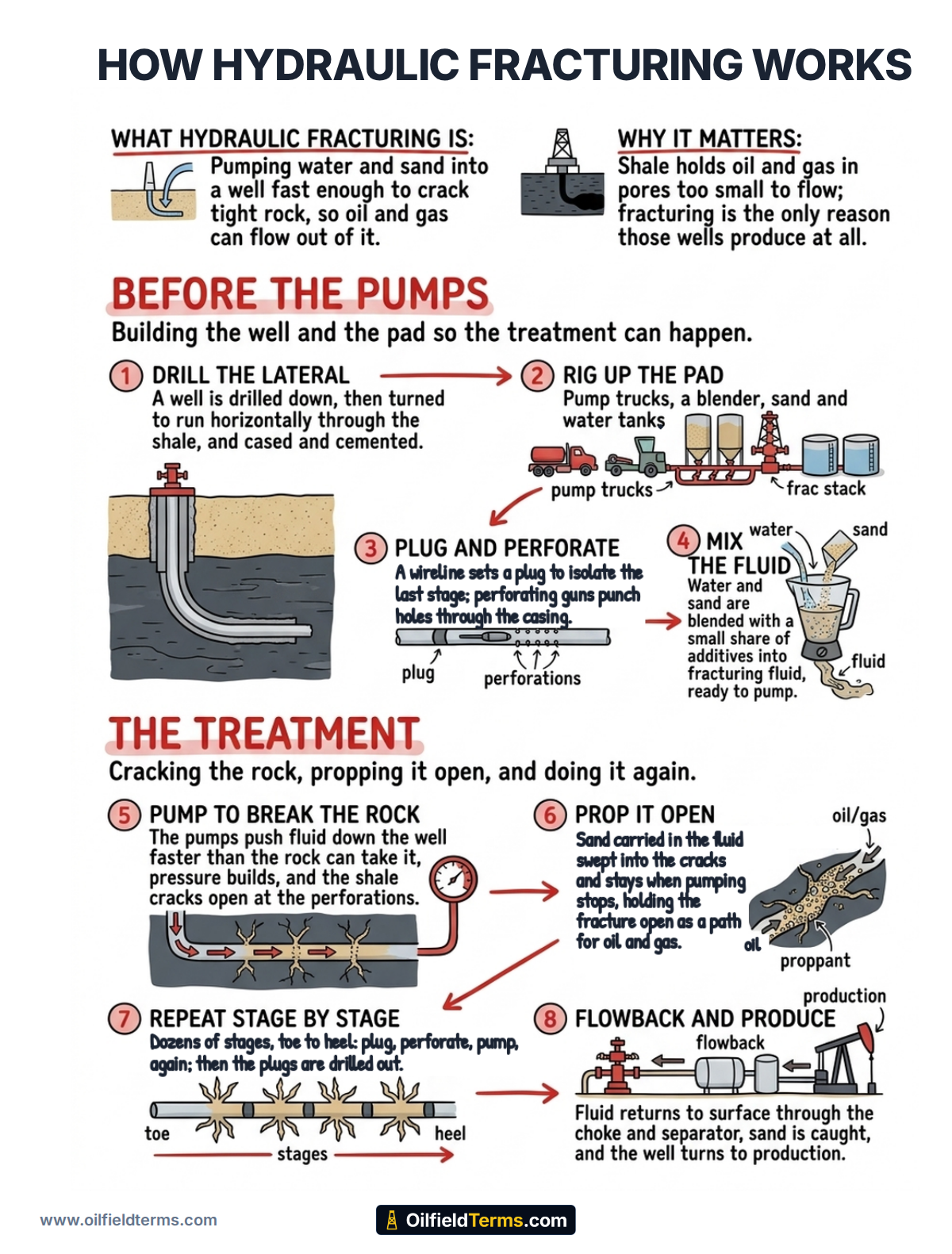
Hydraulic fracturing is two jobs pretending to be one. The first is to open tight rock with pressure: pump water into a well faster than the rock can accept it until the rock cracks. The second is to keep it open with sand once the pumps stop. Everything else on a frac pad exists to do those two things stage by stage along a horizontal well without damaging it. This infographic draws the eight steps in order, neutrally and technically; the notes underneath link every term to its full definition.
Key takeaways
- Shale holds oil and gas in pores far too small for them to flow to a well on their own. Hydraulic fracturing is what makes those wells produce at all; conventional reservoirs mostly do not need it.
- The fluid is mostly water and sand. The water breaks the rock; the sand, the proppant, holds the cracks open afterwards. Additives are a small share of the total.
- A treated lateral is not one giant crack but a comb of many short fractures, typically a few hundred feet tall, created in dozens of separate stages.
- The stage sequence is plug and perf: isolate the last stage, perforate the next, pump, repeat from the toe of the lateral back to the heel.
- The job is proven in flowback, and how hard the well is pulled in its first weeks decides how much of the fracture conductivity survives.
What the treatment actually does
Rock at depth is squeezed from every direction by the weight of everything above it. Pump fluid into a sealed section of well faster than the rock can absorb it and the pressure in the wellbore climbs until it exceeds what the rock can resist; at that moment the rock splits, and the crack grows in the direction the earth resists least. Stop pumping and the earth closes the crack again, which is why the fluid carries sand: grains left in the fracture prop it open a fraction of an inch, enough for oil and gas to drain from the shale into the well for years. Every design decision on a pad, from pump rate to sand grain size, follows from those two facts.
Use this infographic on your site
This diagram is free to republish. Copy the code below into any page, blog post or learning platform that accepts HTML; it embeds the full-size image and keeps a visible credit link back to this page, which is the only condition. If you are a trainer or a teacher putting it on a slide or a handout, you need no permission and no attribution at all.
Prefer a file? The full-size PNG is here. A credit that reads “Infographic by OilfieldTerms.com” with a link to this page is all we ask.
The eight steps
1. Drill the lateral
A shale well is drilled vertically to a kick-off point, turned through a curve, and then run horizontally through the target rock for a mile or more: a horizontal well. The lateral is cased and cemented like the rest of the well, so the treatment reaches the rock only through holes deliberately punched in the casing. In most plays the lateral sits thousands of feet below the deepest fresh water, separated from it by the surface and intermediate casing strings described in How an Oil Well Works.
2. Rig up the pad
A frac fleet arrives: a line of high-pressure pump trucks, a blender, sand silos or containers, water tanks or a pit, chemical units and a data van. They connect through a manifold to the frac stack, a set of high-pressure valves bolted onto the wellhead for the duration of the job. The whole assembly is pressure-tested before the first stage.
3. Plug and perforate
A wireline tool string is pumped down the lateral carrying a plug and a set of perforating guns. The plug is set to isolate whatever has already been treated; the guns fire shaped charges in clusters, cutting perforations through the casing and cement into the shale. The method is called plug and perf, and it is why the lateral is treated from its far end, the toe, back toward the heel.
4. Mix the fluid
At the blender, water and sand are combined with a small share of additives into the fracturing fluid. In a slickwater design the main additive is a friction reducer that lets water be pumped at very high rates; gelled designs add a thickener to carry more sand; a foam design uses nitrogen or carbon dioxide where water is scarce or the rock is sensitive to it. The sand concentration is ramped up through each stage.
5. Pump to break the rock
The pumps push fluid down the well faster than the rock can take it. Pressure at the perforations climbs until it exceeds the rock’s strength and the stress holding it shut, and the shale breaks down: a fracture opens and grows outward as pumping continues. Engineers watch the pressure trace on every stage; the breakdown, the treating pressure and any sudden rise are the language of the job. Before the main treatment a mini-frac or a diagnostic fracture injection test may be pumped to measure how the rock will respond.
6. Prop it open
Proppant sand carried in the fluid is swept into the fractures. Fine grains go first to reach the far ends, coarser grains follow near the well. When the pumps stop the earth closes the fracture onto the sand, which holds it open as a permeable path; how well that path carries fluid is the fracture conductivity. The failure the crew guards against is a screen-out, where sand bridges and the pressure spikes with the stage unfinished.
7. Repeat stage by stage
Plug, perforate, pump, again. A long lateral is treated in dozens of stages, each with its own design and its own pressure record, and on a multi-well pad the fleet often alternates between wells so that one is being perforated while another is being pumped. When the last stage is done the plugs are milled out with coiled tubing and the whole lateral is open to flow. In tight carbonate rock the same logic is applied with acid instead of sand, an acid frac; offshore sand-control wells use a short, packed version called a frac pack.
8. Flowback and produce
The well is opened through a choke and the flowback begins: fracturing fluid, formation water, sand and the first oil and gas return through a sand separator and a test separator. The choke is opened in steps, because pulling too hard drags proppant back out of the fractures and crushes what remains. When the returning fluid has cleaned up the permanent flowline is tied in and the well turns to production. Pressure changes felt in a neighbouring well during the job, a frac hit, are watched for on crowded pads.
A worked example: one stage on a pad
The wireline crew pumps a plug and a gun string down the lateral and sets the plug just above the stage finished an hour ago. The guns fire four clusters across the next stretch of shale and are pulled to surface. The frac crew opens the stack and brings the pumps up to rate on slickwater until the pressure trace shows the rock has broken down, then the blender begins adding sand, lean at first and rising through the stage. Forty minutes later the designed sand has been placed, the pumps are brought down, the pressure bleeds off and the stack is closed. On the next well over, the wireline crew has already set the following plug. Repeated for the length of the lateral, that is the whole job; then a coiled tubing unit mills out every plug and the well is flowed back.
Where it goes wrong
- Screen-out. Sand bridges in the fracture or the perforations, pressure spikes, and the stage ends early with sand in the wellbore to clean out.
- Frac hits. A fracture connects with an offset well, sending pressure and fluid into it; on tight spacing it can damage the neighbour’s production.
- Uneven stages. The fluid takes the few clusters that broke down easiest and leaves the rest of the stage untreated; limited-entry perforating and diverters are the countermeasures.
- Stuck tools. A wireline string or a plug that will not come out blocks the lateral until it is fished or milled.
- Aggressive flowback. Too hard a drawdown flows proppant back and embeds and crushes what remains, giving up conductivity the treatment paid for.
- Water handling. The returning fluid has to be stored, recycled or disposed of, and disposal-well injection has been linked to induced earthquakes in some basins, which has tightened permits for it.
Variants
- Slickwater, gel and hybrid. Slickwater relies on rate and carries sand by velocity; gel relies on viscosity and carries more sand per gallon; hybrids pump slickwater first and gel last.
- Foam. Nitrogen or carbon dioxide foam uses far less water and suits water-sensitive rock.
- Acid frac. In carbonate rock acid etches the fracture faces so they stay conductive without sand.
- Frac pack. A short, high-concentration treatment combined with a gravel pack for sand control in weak offshore sands.
- Sliding sleeves. An alternative to plug and perf: ported sleeves run with the casing and opened by dropped balls, faster but less precise.
Frequently asked questions
What is in fracturing fluid?
Mostly water and sand. The additives, typically a small percentage of the total, include a friction reducer, a biocide, a scale inhibitor and a surfactant; gelled fluids add a thickener. Operators in most jurisdictions disclose the additives used on each well.
How much water does it use?
Several million gallons for a long modern lateral, which is why reuse of flowback and produced water has grown. The figure varies with lateral length, stage count and fluid design.
How far do the fractures go?
Typically a few hundred feet from the well, in most plays thousands of feet below any fresh-water aquifer. Fracture growth is limited by the rock layers above and below and is monitored with microseismic surveys on many jobs.
Does fracturing cause earthquakes?
The treatment itself has been linked to small tremors in a few areas. The larger induced earthquakes associated with the industry are mostly tied to high-volume disposal of wastewater in injection wells, which is a separate operation, and regulators have restricted injection where that link was found.
How long does a frac job take?
Days to a few weeks per well depending on the number of stages, followed by days to weeks of flowback before the well is on stable production.
What is a stage?
One isolated section of the lateral treated as a unit: plugged off from the last, perforated, and pumped with its own designed volume of fluid and sand. A lateral may have dozens.
Does every well need fracturing?
No. Conventional reservoirs with good permeability flow without it. Shale and tight rock have almost no natural permeability, so fracturing is what makes them produce at all.
Where does the story start?
With the rock itself. How Oil and Gas Form explains why shale is both the source and the reservoir, and How an Oil Well Works covers the well the treatment is pumped through.
Part of the OilfieldTerms.com guides. Every term above links to its definition in the glossary.